Earlier this month, a group of
Jewish Temple
Mount activists sent a letter to Israeli Prime Minister Benjamin Netanyahu
asking him to allow them to offer the ritual Passover on the Temple Mount to
end the coronavirus pandemic. I have not
seen any reports that the rite took place on the location. However, more information is available
concerning those individuals who were behind the request. Several
leaders, including Rabbi Chaim Kanievsky, Rabbi Shmuel Eliyahu, and Rabbi
Menachem Makover all supported the endeavor.
Last year the Jewish
Passover was celebrated in a variety of ways in Jerusalem, which included
priests from the Jewish Temple Institute enacting a sacrifice of a lamb from an
area overlooking the mount. Those
calling for the offering of the Passover lamb this year had argued that an
altar could be placed on the mount and the Passover offering carried out.
Saturday, April 11, 2020

Saturday Lenten Reflection 2020
Today is Jesus’ Sabbath
Although in the ground His body lay,
Forever remember it will not stay,
Soon to arise like firstfruits,
We cherish this everlasting truth.

Friday, April 10, 2020
Friday Lenten Reflection 2020
On this day
in the Gospel of Mark, Jesus is handed over by Jewish priests and Pilate to be
crucified. He is mocked by soldiers and those
who passed by: “Aha! You who would destroy the temple and build it in three
days, save yourself, and come down from the cross.” However, when Jesus cried aloud and breathed
his last, the curtain of the temple was torn (σχίζω) in two from
top to bottom. There is a parallel with
the Baptism of Jesus in the Jordan by John the Baptist, where the heavens are
torn apart (σχίζω) and a voice from heaven says, “This
is my beloved Son.” The irony, though,
is at the cross the Roman centurion—and not the priests —confesses, “Truly this
man was God’s Son.” Jesus, bread and
wine, the Eucharist, and the significance of the temple are moving westward.
 |
| Stone of Anointing in the Church of the Holy Sepulcher located west of the Temple Mount. |
 |
| This woman was doing something and walking right towards me. She also walked right up to me. |
 |
| Faces in the Holy Sepulcher. |
 |
| More faces in the Holy Sepulcher. |
 |
| Here is a side chapel within the Church of Holy Sepulcher where I participated in the Eucharist. Although I enjoyed my visit to the Old City and the Temple Mount, this chapel holds a special and unique sense of God's presence. |
Thursday, April 9, 2020
Thursday Lenten Reflection 2020
On this day in the Gospel
of Mark, Jesus and the disciples celebrate the Jewish Passover. While they were eating Jesus instituted what
we now call the Lord’s Supper. Jesus
took bread and wine blessed and gave thanks (εὐχαριστήσας, eucharistesis),
whose root is the same for the word Eucharist.
Bread and wine are not only associated with Passover, but also with the
Feast of First Fruits, which is the Jewish feast associated with the
covenant. Afterwards, Jesus and his
disciples went out to the Mount of Olives.
In the Garden of Gethsemane, he prays, and is betrayed, arrested, and
falsely accused: “We heard him
say, ‘I will destroy this temple that is made with hands, and in three days I
will build another, not made with hands.’ ”
The Eucharist will become the capstone of Jesus’ sayings and actions
regarding the Second Jewish Temple.
 |
| Mount of Olives: the building in the center is the Church of All Nations. Slightly to the left is a garden and olive grove. The picture was taken during summer 2017 trip to Israel (LFL). |
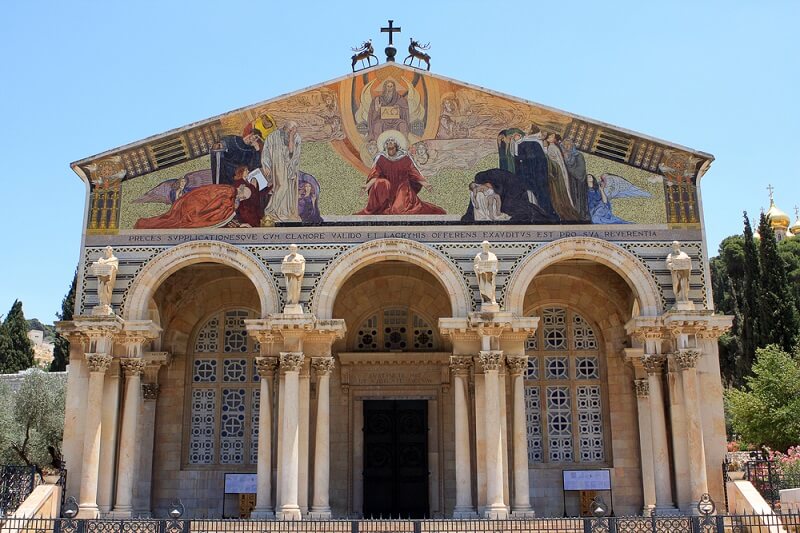 |
| Church of All Nations: picture from BeinHarim Tourism website. |
 |
| These are two ancient olive trees in the garden next to the Church of All Nations. They reminded me of the two witnesses. The trees are around 900 years old. There are olive trees around the Mediterranean that are nearly 2000 years old and some are said to still bear fruity olives (LFL). |
 |
| More trees slightly north of the Mount of Olives (LFL) |
 |
| This is a closeup of one of the two ancient olive trees. The center reminded me of the unity of the two hearts. |
Tuesday, April 7, 2020
Tuesday Lenten Reflection 2020
On this day in the Gospel
of Mark, Jesus talks about the end. He and
his disciples head toward Jerusalem.
They see the withered fig tree and Jesus uses the opportunity to teach
about the importance of prayer, faith, and forgiveness. “If you say to this mountain, “Be taken up
and cast into the sea,” and do not doubt in your heart, it will be done for
you.” In the court of the Jerusalem
Temple, he teaches on the importance of loving God with heart, soul, mind, and
strength, and loving one’s neighbor as oneself.
In the afternoon, they come out of the temple. One of his disciples commented on the stones and
buildings of the temple. They learn that
in their lifetime, the end of the temple would come to pass. And it happened for only the artificial temple
mount still stands today.
 |
| The Western Wall is only a portion of the entire wall of the Temple Mount. Herod the Great built walls around the high point of what is considered Mount Moriah. The area inside the walls was filled in and leveled so that Herod could build his massive temple courts and the temple itself . LFL (Summer 2018). |
 |
| LFL (Summer 2018) |
 |
| LFL (Summer 2018) |
Monday, April 6, 2020
Monday Reflection 2020
When I was in Gaming,
Austria, I heard a story that the Cistercian monks in the village would say to
one another on occasions, Frater memento mori!
“Brother, remember to die” or “Brother, remember your death.” I was told that this was not a morbid or mundane
saying, but a reminder to look forward to the hour of death. The end will come; however, it is a pivotal time. Like the door hinge, one of its ends actually
swings open in another dimension. During
this time of Lent, let us turn our minds from things that will pass. Let us at least consider the possibility
there is more to life than living in this material world with its material
prosperity and simply dying. On this
day, Jesus enters the Second Jewish Temple and stresses the more important
things (Mk 11:15-17).

Sunday, April 5, 2020
Palm Sunday 2020
I
have been reflecting on my visits to Israel in the summer of 2017 and
2018. The experience was awe-inspiring
and even to this day, I continue to learn from the encounters with people,
places, dates, and faces. One of the
sites that capture my attention is the eastern gate in the old city walls. It is not certain that the existing gate is
the one that existed during the time of the Second Temple and the time of Jesus. A curious think about it, though, is that it
is closed. There are various stories
about why this happened. One account
says it is shut until the coming of the Messiah. Another tale explains that it remains closed
to prevent the coming of the Anti-Christ.
Its shape reminds me of the tablets that Moses brings down the mountain
in the movie “The Ten Commandments.”
 |
| Eastern Gate in the Western Wall, Jerusalem (Summer 2017) LFL |
 |
| Western Wall (Summer 2017) LFL |
 |
| Jerusalem taken from Mount of Olives (Summer 2017) LFL |

Subscribe to:
Posts (Atom)
A Journey of Hope marks the sixtieth anniversary of Nostra Aetate by tracing the development of Catholic interreligious dialogue from it...

-
 On this day in the Gospel of Mark, Jesus is handed over by Jewish priests and Pilate to be crucified. He is mocked by soldiers and those ...
 -
 Israeli-Arab members of the Knesset arrived at the Lions Gate in order to join the Palestinians for evening prayer outside the Temple Moun...
 -
 Last Friday, a group of three Arab-Israelis from Umm al-Fahm entered the city of Old Jerusalem through the Lion’s Gate. They had made the...